Are You Planning a Letter of Intent for Alaska Rural Health Transformation Fund Grants?
From now until October 2026, the State of Alaska will be awarding $272M in rural health award distributions, part of the $50B Rural Health Transformation Program (RHTP).
On 10th Feb. 2026, the Alaska DoH (Department of Health) did a webinar on RHTP. This is not a typical grant program. It is a system redesign initiative. DoH emphasized that RHTP funds are not meant to fill long-standing funding gaps or replace existing resources. Instead, they are intended for strategic investments that can continue to deliver value after the five-year funding period ends.
From 17 Feb to 11 March, DoH will open a portal to accept Letter of Intent applications. If you want funding, you must submit a letter of intent (LOI).
2,000 attendees joined Alaska’s update webinar on February 10, 2026. A lot of funds are up for grabs, $217M, BUT this process will still be highly competitive. Even if every organization sent 2 representatives to the call, and we subtract 25% as vendors, that’s still almost 900 applicants.
Important: Start early!
All applicants must have an Employer Identification Number (EIN) from the IRS, and a Unique Entity Identifier from SAM.gov. We recommend taking this step first. Sometimes SAM can be delayed or request additional documents.
Any business entity, non-profit, healthcare organization, or government entity can get an EIN and UEI. Many will already have one.
- For entities without a UEI: First, check your entity status here. If it doesn’t appear, ask your colleagues, preferably the administrators. To acquire a UEI, you or colleagues (don’t step on toes!) should follow this guide from SAM.gov.
- For Unincorporated groups or coalitions without legal status: The lead organization in the coalition should complete the form, referring to partners throughout.
- For clinicians or consultants without a registered business: You will have to register an entity with the Secretary of State in Alaska to get an EIN then UEI.
What do you need to design at this stage?
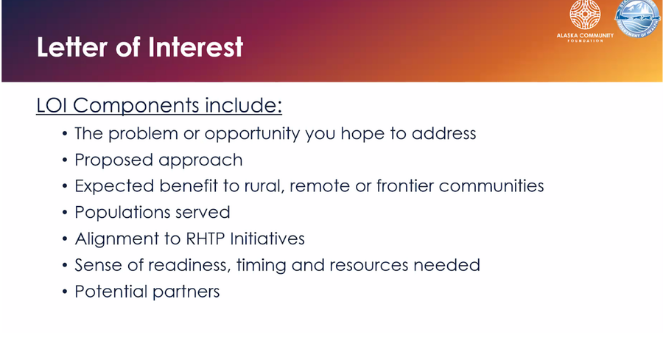
All prospective awardees must complete a Letter of Intent on the grant portal. Here is what you need to include.
Before you write a single sentence of your response, pause. Do not start with: “How can we use this money?” Start with: “What do WE need to transform care in our community?” Most ideas fit into one of three categories:
|
A. Ongoing or Recent Work That Needs to Expand |
B. Impactful but Underfunded Areas |
C. New Initiatives That Need Startup Funding |
|
You may already be running a successful telehealth pilot, testing a new workforce model, building regional partnerships, or launching a behavioral health access initiative. If the model is working but limited by scale, RHTP may be an opportunity to expand access geographically, increase service capacity, strengthen staffing stability. This is often the strongest category because it demonstrates momentum and feasibility. |
Some services are critical but chronically constrained. For example, rural behavioral health access, care coordination across hub-and-spoke systems, or workforce retention strategies If an area is high-impact, proven to matter, or under-resourced, you may be able to frame your LOI as a strategic investment to unlock sustainable improvement. But be careful. RHTP is not designed to backfill historical funding gaps. You must show how this funding changes the model, not just fills the hole. |
You may have a defined concept that expands care access, strengthens community health systems, integrates workforce and technology, or redesigns how care is delivered If the concept is clear but requires structured planning, workforce architecture design, financial modeling, or tech integration, then planning or readiness funding may be appropriate. |
Consider what the State is looking for: 6 Initiatives Within 3 Goals
Your LOI must clearly align with at least one initiative under the three goals. Here is how the structure breaks down.
Goal 1: Promote Lifelong Health and Wellbeing
-
1. Healthy Beginnings: Projects that improve early life outcomes, maternal health, and long-term wellness.
-
2. Health Care Access: Projects that expand or redesign access for rural, remote, and frontier populations.
-
3. Healthy Communities: Projects that strengthen community-based systems, prevention, and integrated care models.
Ask yourself: Does this directly improve access or long-term health outcomes?
Goal 2: Build Sustainable, Outcomes-Driven Health Systems
- 4. Pay for Value and Fiscal Sustainability Projects that improve financial durability, value-based models, or system efficiency. This is about sustainability beyond the five-year funding period, reducing long-term costs, and strengthening care delivery models Ask yourself: Does this make our system more durable?
Goal 3: Drive Workforce and Technology Innovation
-
5. Strengthen Workforce Projects that improve recruitment, retention, training pipelines, or workforce redesign. Important: If your project includes incentives tied to relocation, federal five-year commitment rules may apply. Design accordingly.
-
6. Spark Technology and Innovation: Projects that modernize tools, integrate systems, and enable new models of care delivery. Technology alone is not enough. It must connect to improved access or outcomes.
This alignment has a direct effect on your competitiveness. When your proposal clearly fits within one of the six established initiatives, reviewers do not have to guess how it supports the program’s goals or whether it advances the state’s strategy. You make their job easier. That clarity reduces perceived risk, strengthens your credibility, and signals that you understand both the policy framework and the funding intent. In a program where readiness, sustainability, and measurable impact are critical, anchoring your idea to an existing initiative increases the likelihood that it will be routed forward, prioritized appropriately, and ultimately funded.
Helpful Links
- The Alaska Department of Health’s webpage on the RHTP.
- Summary of DOH webinar, 10 Feb.
- Webinar recording and Q&A; Webinar slides
- The Rural Health Workforce Transformation Hub
- Writing a WINNING Application for RHTP Grant Funds
Design Your Program and Response
Now is the moment to shape your idea into something fundable. This means clearly defining the problem you are solving, mapping it to one of the six RHTP initiatives, outlining measurable outcomes, and showing realistic readiness for year one. Strong Letters of Interest are not vague concepts; they are structured, aligned, and executable.
The word count for each response is around 350-400 words (2,450-2800 in total). If you want help designing your program, applying, and implementing, we are here for you.
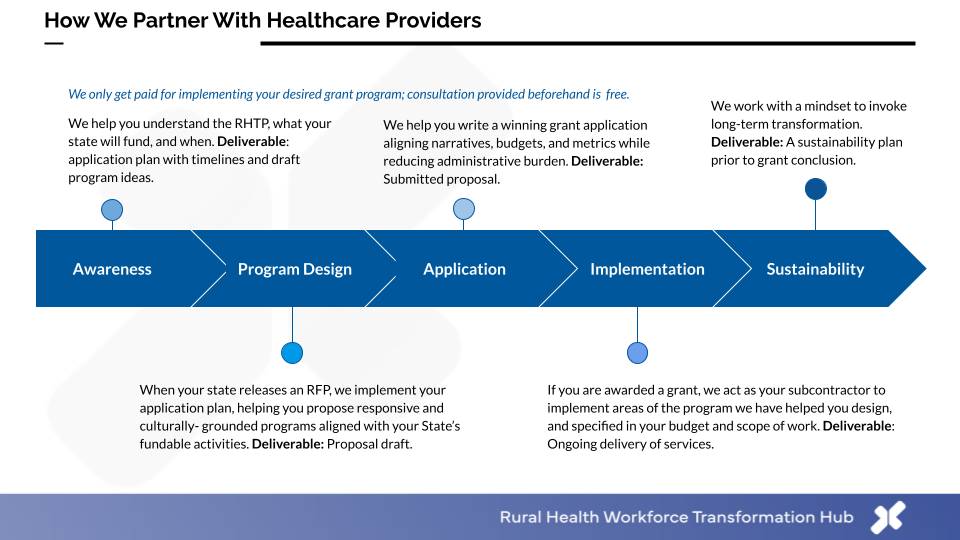
Since 2019, we have helped partnered clients generate $1M in revenue from State healthcare grants. Our footprint in Alaska spans four years helping the South Eastern Alaska Regional Health Authority with workforce needs, including 20 accepted job offers by nurses in the lower 48. We are closing following the RHTP and offer FREE strategic advice and grant writing support to potential applicants. Click here to learn more.

Founder of the Rural Healthcare Transformation Hub @ Nurse Recruitment X
Looking to secure Rural Health Transformation Program funds and fix your workforce shortages? Our Rural Health Transformation Hub helps rural hospitals, clinics, and home care agencies design winning proposals and build the pipelines needed to recruit and retain staff. We combine grant support with real recruitment expertise, giving you a low-risk way to compete for funds and implement workforce solutions that work.