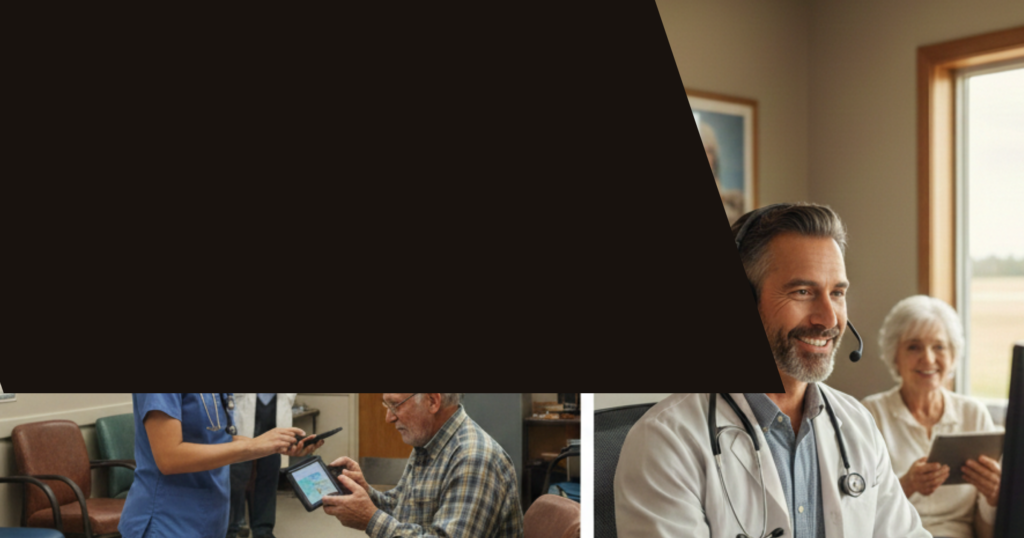
For rural providers, expanding access has often come at a cost: longer hours, broader scopes of practice, and rising burnout among already stretched care teams. Telehealth is frequently promoted as the solution—but many clinicians worry it will simply add more work to an unsustainable system.
Insights from Rural Health Transformation Program (RHTP) applications and national rural health guidance show a different reality. When designed correctly, telehealth can expand access while reducing burnout, not worsening it.
Across submissions to the Centers for Medicare & Medicaid Services, telehealth consistently appears as a workforce-support tool—not just a patient access strategy.
The False Tradeoff: Access vs. Burnout
Rural providers are often forced into an impossible choice:
- Expand services and overload clinicians, or
- Protect staff and limit access
Telehealth breaks this tradeoff by changing how care is delivered. RHTP applications repeatedly emphasize that burnout is driven less by volume and more by isolation, inefficiency, and unsupported decision-making. Telehealth directly addresses those drivers.
Expanding Access by Sharing the Load
Telehealth expands access not by asking rural clinicians to see more patients, but by redistributing responsibility across teams and regions.
Effective telehealth models enable:
- Virtual specialty consults that keep patients local
- Shared coverage for nights, weekends, and complex cases
- Regional hub-and-spoke care models
Instead of absorbing every clinical decision alone, rural clinicians gain backup. Access improves because care stays local—and burnout drops because clinicians are no longer carrying everything themselves.
Reducing Burnout Through Clinical Support
One of the strongest predictors of burnout in rural settings is practicing without support. Telehealth reduces this risk by providing:
- Real-time consultation with specialists
- Tele-mentorship for early-career clinicians
- Peer-to-peer case discussion
RHTP applications from frontier and western states consistently link professional isolation to turnover. Telehealth mitigates that isolation by making rural clinicians part of a broader care team—even when geography is vast.
Keeping Care Local Without Overloading Staff
Sending patients out of the community for care creates frustration for both clinicians and families. Telehealth-enabled models allow rural providers to manage more care locally without increasing workload by:
- Supporting diagnosis and treatment decisions virtually
- Reducing unnecessary transfers and referrals
- Allowing clinicians to focus on care they are trained to provide
Clinicians report higher job satisfaction when they can practice meaningful, complete care—rather than acting as a referral gateway.
Smarter Workflows, Not Longer Days
Burnout is rarely about caring too much—it’s about inefficient systems. Telehealth supports smarter workflows by:
- Reducing travel time for providers and patients
- Enabling flexible scheduling and coverage models
- Integrating behavioral health and specialty support into primary care
When telehealth is embedded into workflows—rather than layered on top—it saves time instead of consuming it.
Access That Patients Want, Support That Clinicians Need
Telehealth succeeds when it serves both sides of the care equation. RHTP applications and rural health guidance highlight that adoption improves when telehealth:
- Meets patients where they are
- Respects clinicians’ capacity and limits
- Strengthens trust and continuity
When clinicians feel supported, patient access expands naturally—without pushing teams toward exhaustion.
What Burnout-Safe Telehealth Looks Like
Across RHTP submissions, telehealth programs that expand access without expanding burnout share common features:
- Designed around workforce support
- Integrated into team-based care models
- Used to reduce isolation and risk
- Measured by stability and retention—not just volume
Telehealth works best when it is treated as workforce infrastructure, not an add-on service.
Access Should Strengthen the Workforce, Not Drain It
Rural providers do not need more pressure to do more with less. They need systems that allow them to deliver care safely, collaboratively, and sustainably.
The lesson from RHTP is clear: telehealth expands access most effectively when it protects the people delivering the care. When designed with burnout in mind, telehealth doesn’t stretch rural teams thinner—it makes them stronger.

Founder of the Rural Healthcare Transformation Hub @ Nurse Recruitment X
Looking to secure Rural Health Transformation Program funds and fix your workforce shortages? Our Rural Health Transformation Hub helps rural hospitals, clinics, and home care agencies design winning proposals and build the pipelines needed to recruit and retain staff. We combine grant support with real recruitment expertise, giving you a low-risk way to compete for funds and implement workforce solutions that work.