
Alaska is finalizing its Rural Health Transformation Program initiatives and implementation approach as CMS prepares to award $50 billion nationally, with Alaska’s share flowing through the Department of Health. For rural CEOs, CFOs, and HR leaders, the 2026 Alaska RHTP convening is the clearest window into how the state will prioritize projects, define eligible workforce uses, and set expectations for readiness, data, and compliance.
Executives who show up prepared can:
Position their organizations early for technical assistance, partnership support, and downstream grant opportunities tied to RHTP.
Shape how workforce-focused initiatives are operationalized in frontier and tribal settings, not just road-system facilities.
What the Alaska RHTP convening is
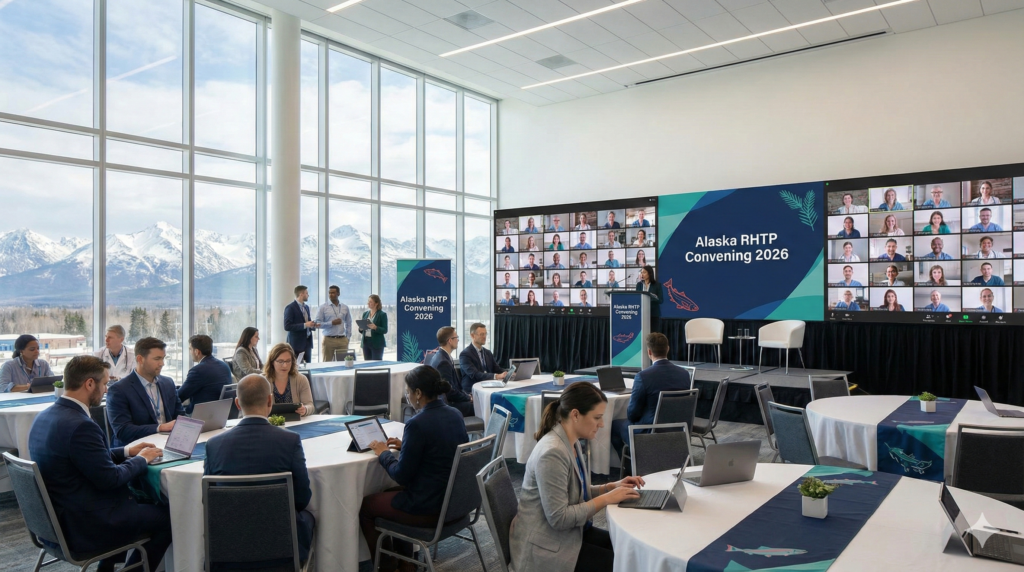
The Alaska RHTP convening is a multi-day, hybrid event hosted by the Alaska Department of Health to align health care organizations, community partners, and vendors around the Rural Health Transformation Program. It combines a statewide virtual briefing, an in‑person strategy day, and a structured vendor and DOH “office hours” day in Anchorage.
Core event structure:
-
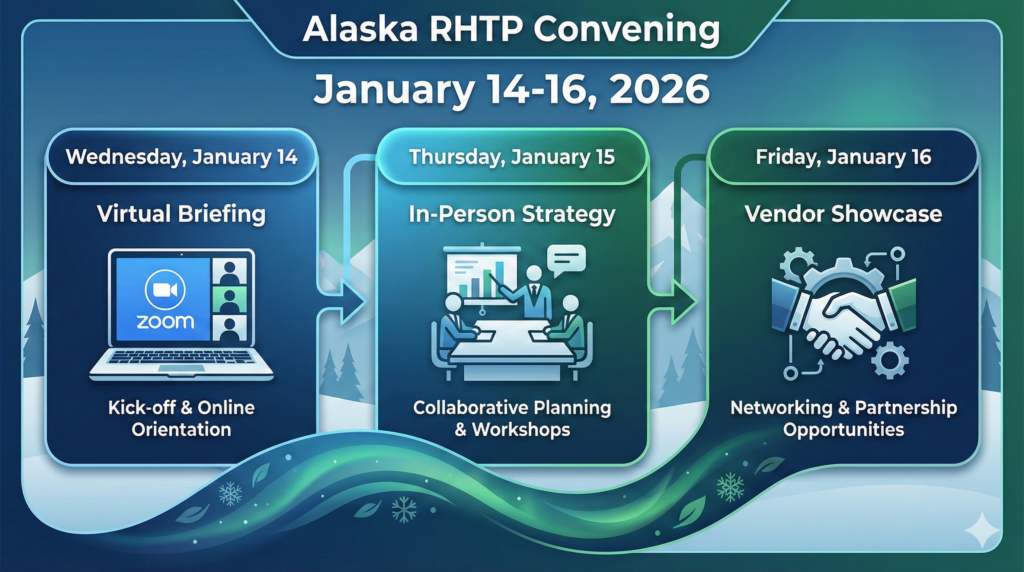
- Virtual briefing – Wednesday, January 14 (9:30–11:30 AM AKT, Zoom)
Focus: Alaska’s RHTP vision, approved initiative areas, anticipated timelines, and early signals on how CMS and the state expect funds to be deployed.
- Virtual briefing – Wednesday, January 14 (9:30–11:30 AM AKT, Zoom)
-
- In‑person kick‑off – Thursday, January 15 (9:00 AM–5:00 PM, Hilton Downtown Anchorage)
Focus: Deeper dives on the state’s implementation approach, funding and application processes, and facilitated discussions on how RHTP goals translate into specific regional and workforce strategies.
- In‑person kick‑off – Thursday, January 15 (9:00 AM–5:00 PM, Hilton Downtown Anchorage)
-
- Vendor showcase & DOH office hours – Friday, January 16 (9:30 AM–5:00 PM, Hilton Downtown Anchorage)
Focus: Structured engagement with technology, data, and workforce solution vendors, alongside the opportunity to book small‑group or one‑on‑one time with Alaska DOH leadership to discuss project ideas and readiness.
- Vendor showcase & DOH office hours – Friday, January 16 (9:30 AM–5:00 PM, Hilton Downtown Anchorage)
Participants typically include state leaders, tribal and borough health organizations, critical access and PPS hospitals, FQHCs and RHCs, behavioral health providers, workforce boards, and technical assistance partners.

Key announcements and takeaways executives should watch for
The convening is designed to serve as both a briefing and a practical checklist for RHTP workforce strategy. Executives should task a leader to capture, in writing, clarifications and commitments made in each of these areas.
Policy direction and initiative focus
-
- How Alaska’s final RHTP initiatives (e.g., Health Care Access, workforce development, regional planning, data, and technology) will be prioritized for early funding cycles.
-
- The department’s interpretation of allowable workforce uses,such as training, recruitment pipelines, retention supports, and technical assistance, within CMS’s broader RHTP categories.
Workforce readiness expectations
-
- What “ready to implement” means for Alaska DOH: examples of acceptable project maturity, partnership documentation, and governance structures.
-
- Signals on priority workforce gaps (e.g., behavioral health, maternal care, primary care, long‑term care) that emerged from Alaska’s RFI process and CMS-aligned feedback.
Data, reporting, and evaluation
-
- Required baseline data sources (claims, EHR, staffing, access metrics) and minimum reporting capabilities expected of RHTP-funded workforce projects.
-
- Preferred outcome measures for workforce-focused proposals—such as vacancy reduction, time‑to‑fill, avoidable transfers, travel nurse dependence, or access in off‑road communities.
Eligibility, documentation, and compliance
-
- Which Alaska entity types will be prioritized in early RHTP cycles (e.g., CAHs, tribal health organizations, frontier clinics, long‑term care facilities).
-
- Documentation standards the state will expect to see: non-duplication of other federal funds, alignment to specific RHTP initiatives, sustainability planning, and community engagement evidence.
What most leaders get wrong about RHTP convenings
Many executives still treat RHTP convenings like informational conferences rather than as working sessions that directly shape funding odds and implementation risk. That mindset leads to three common failures:
-
- Showing up without a draft workforce thesis. Teams attend to “learn what’s possible” but bring no pre‑defined view of their highest‑value workforce problems, so they struggle to ask pointed questions or secure directional feedback from DOH.
-
- Delegating attendance too low in the organization. Sending only grant writers or mid‑level managers means the organization cannot credibly commit to cross‑system changes, weakening its position when DOH looks for serious implementation partners.
-
- Focusing on single-point fixes. Leaders anchor on travel‑nurse reduction, sign‑on bonuses, or a new scheduling tool instead of designing an integrated workforce transformation project that matches the scale of RHTP.
The result is a gap between Alaska’s articulated RHTP vision and what shows up in applications: fragmented, short‑term staffing solutions instead of durable regional workforce strategies.
How to use the convening to build a serious workforce strategy
RHTP is explicitly structured to reward integrated, regional, and sustainable workforce approaches tied to access, quality, and cost—not ad‑hoc hiring fixes. The Alaska RHTP convening is where rural organizations can align their internal workforce plans with the state’s multi‑year transformation roadmap.
1. Go in with a clear workforce problem statement
Before January 14, your executive team should agree on 1–3 core workforce challenges that RHTP funding could realistically solve within five years. These should be framed in terms that matter to DOH and CMS:
-
- Access risk (e.g., risk of service line closure, ER diversion days, maternity or behavioral health deserts).
-
- Systemic staffing fragility (e.g., chronic reliance on high‑cost locums or agency staffing, single‑provider coverage in critical specialties).
-
- Structural barriers in frontier and tribal communities (e.g., housing, training access, geographic isolation) where RHTP investments could build lasting capacity.
2. Map your problem to Alaska’s RHTP initiatives
Use the state’s published initiative framework to anchor your thinking before the convening. Typical initiative categories relevant to the workforce include:
-
- Health Care Access and Regional Care Models – opportunities to embed workforce strategies in regional service redesign, virtual care expansion, and itinerant models.
-
- Workforce Development and Support – initiatives focused on pipelines, training, retention, and community-based supports.
-
- Data, Technology, and Care Coordination – where workforce investments are tied to tools that enable teams to operate at the top of license across vast geographies.
Your convening objective should be to confirm: which initiative your workforce project best fits, what success metrics DOH will prioritize, and what technical assistance the state will offer.
3. Use the three days differently—not redundantly
Executives should structure the event as a staged strategy process, not three variations of the same meeting.
| Day & format | Strategic purpose for executives | Concrete outputs to bring home |
|---|---|---|
| Virtual – Jan 14 | Align on Alaska’s RHTP vision, initiative areas, and funding timelines; capture policy “guardrails” and early DOH signals. | One-page summary of initiative alignment for your organization; preliminary list of eligible workforce concepts. |
| In-person – Jan 15 | Pressure-test 1–3 draft workforce project concepts in breakout sessions; understand peer priorities and partnership opportunities. | Refined project concepts with clearer scope, partners, and data requirements; list of potential co-applicants or regional collaborators. |
| Vendor & DOH day – Jan 16 | Identify specific technology, TA, and recruitment partners; reality-check implementation feasibility and compliance with DOH. | Shortlist of vendors and TA partners; notes from DOH office hours on documentation expectations and next milestones. |
Practical workforce planning moves to make at the convening
How to structure your internal team
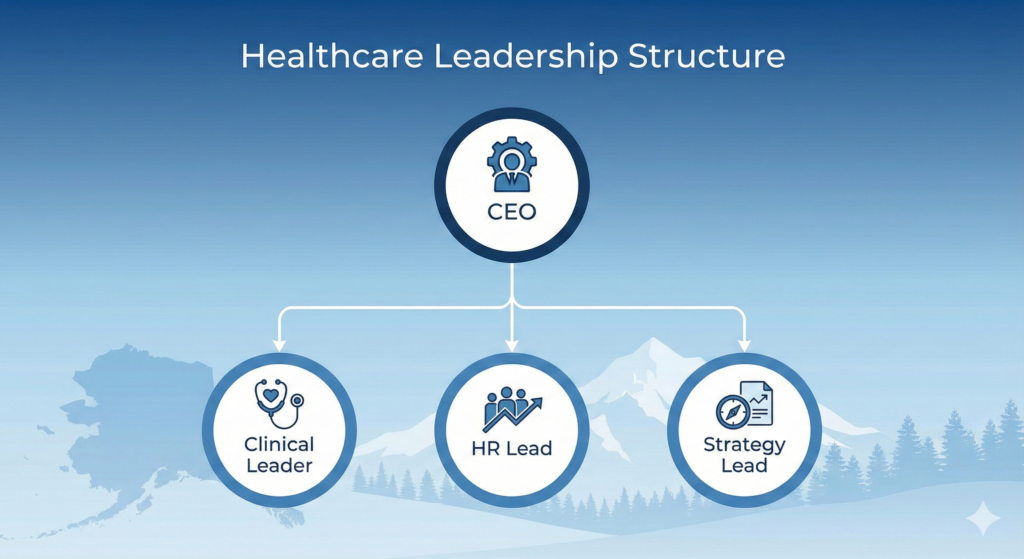
To treat the Alaska RHTP convening as a working session, rural organizations should send a small, empowered cross‑functional team.
Minimum recommended roles:
-
- A C‑suite decision-maker (CEO, COO, or CFO) to commit to system-level changes and multi‑year investments.
-
- A clinical or operations leader who owns staffing, access, or quality for key service lines.
-
- A workforce/HR or recruitment lead who understands pipelines, agency spend, and retention challenges.
-
- A grants or strategy lead who can translate convening guidance into an executable RHTP proposal calendar.
How to use breakout sessions and office hours
-
- Go into each breakout with one specific question: for example, “What would DOH consider sufficient evidence that a regional behavioral health workforce partnership is sustainable beyond RHTP funding?”
-
- Use office hours with DOH to clarify gray zones, such as overlap with other federal funding, multi‑entity applications, and shared workforce infrastructure (e.g., housing, training hubs, virtual supervision).
Converting convening insights into an RHTP‑ready workforce strategy
The real value of the Alaska RHTP convening is what happens in the 30–60 days after you leave Anchorage. Executives should treat the event as the starting point for a disciplined, time‑boxed planning sprint.
1. Formalize your post‑convening deliverables
Within two weeks, your team should produce:
-
- A convening summary memo: 3–5 pages documenting Alaska DOH’s stated priorities, clarified eligibility rules, data and reporting guidance, and key workforce themes.
-
- A shortlist of 1–3 workforce project concepts mapped explicitly to Alaska RHTP initiatives, with rough budgets, timelines, and outcome targets.
Use this memo as the common reference point for all subsequent board and leadership discussions about RHTP participation.
2. Run a focused workforce gap and readiness assessment
Leverage convening guidance to quickly assess your organization’s current state:
-
- Baseline vacancy, turnover, and agency spend in critical roles.
-
- Data capabilities relative to DOH’s expectations for tracking access, quality, and workforce outcomes.
-
- Existing collaborations with tribal partners, borough governments, schools, and housing partners could be formalized into an RHTP application.
Frame gaps not as generic needs but as specific areas where RHTP investments can unlock measurable, multi‑year improvements.
3. Build a regional partnership map
RHTP is biased toward regional solutions and multi‑sector coalitions, and Alaska’s own RFI responses emphasized coordinated workforce strategies. Use the convening to:
-
- Identify neighboring hospitals, clinics, tribal health organizations, and community partners interested in shared workforce projects (e.g., joint housing, training hubs, tele‑supervision, shared recruitment).
-
- Begin drafting governance options (e.g., lead applicant with MOUs, joint steering committees, shared data agreements) that address DOH’s concerns about accountability and sustainability.
Financial, compliance, and operational implications for Alaska rural leaders
RHTP-scale funding can materially change the trajectory of Alaska’s rural workforce, but only for organizations that treat early convenings as part of their execution plan, not just education. Strategic implications include:
-
- Financial: Well‑designed workforce projects can convert high, variable agency spend into structured, funded investments in pipelines, housing, and retention, improving long‑term margins.
-
- Compliance: Early clarity from DOH on non‑duplication of funds, documentation, and reporting can significantly reduce the risk of clawbacks or audit exposure later.
-
- Operational: Aligning workforce initiatives with Alaska’s RHTP initiatives forces organizations to rethink service models, not just staffing levels, especially in off‑road and tribal communities.
What an Alaska rural executive should do next
For CEOs, CFOs, and HR leaders considering the 2026 Alaska RHTP convening, the priority is to convert attendance into a measurable strategic advantage.
Before the event:
-
- Confirm which executives and leaders will attend each day, and assign clear roles and decision rights.
-
- Draft 1–3 preliminary workforce project concepts tied to Alaska’s published RHTP initiatives, with high‑level budgets and outcomes.
During the event:
-
- Use each session to test and refine those concepts against DOH guidance, peer feedback, and vendor capabilities.
-
- Secure explicit notes on what DOH views as strong vs. weak proposals in your context (facility type, region, population served).
After the event:
-
- Launch a 30–60 day internal planning sprint to finalize at least one RHTP-ready workforce project, supported by data, partnerships, and a concrete implementation plan.
Handled with this level of discipline, the Alaska RHTP convening becomes more than an overview of the Rural Health Transformation Program; it becomes the launchpad for a credible, fundable workforce strategy that can hold up under CMS and Alaska DOH scrutiny.
Ready to align your strategy with the $50 Billion RHTP?
Navigating these grant applications can be overwhelming, but you don’t have to do it alone. We are currently providing rural leaders with technical assistance and program design support to help ensure your workforce initiative gets funded.
Let’s get your proposal ready before the deadlines hit.
Click here to book your FREE Rural Health Workforce Strategy Call.

Founder of the Rural Healthcare Transformation Hub @ Nurse Recruitment X
Looking to secure Rural Health Transformation Program funds and fix your workforce shortages? Our Rural Health Transformation Hub helps rural hospitals, clinics, and home care agencies design winning proposals and build the pipelines needed to recruit and retain staff. We combine grant support with real recruitment expertise, giving you a low-risk way to compete for funds and implement workforce solutions that work.